 listicle
Affordable Ways to Decorate Rental Walls: A Renter's Guide
Last Updated: October 31, 2026
Quick Summary
The cheapest way to decorate rental walls is to use damage-free methods that cost nothing to undo, such as adhesive strips, tension rods, and leaning displays. Test any adhesive in a hidden spot first, since textured or fresh paint can lift and cost you your deposit.
- Hanging pictures without nails takes about 15 minutes per frame with adhesive strips.
- Press strips for the full time stated on the package before loading them.
- Test adhesive in a hidden spot, wait a full day, then remove it slowly.
- A file around 6,000 pixels wide supports a large print at 300 ppi.
- Leave peel-and-stick wallpaper test squares for 3-5 days before peeling back.
Table of Contents
- Why Affordable Rental Wall Decor Starts With Damage-Free Methods
- How to Hang Pictures Without Nails: Step-by-Step
- DIY Wall Art on a Budget: Printable Downloads and Simple Frames
- Gallery Wall Ideas for Renters That Move With You
- Peel-and-Stick Wallpaper for Renters: What to Know Before You Apply
- Leaning Displays, Tapestries, and Other No-Hole Options
- Frequently Asked Questions
Why Affordable Rental Wall Decor Starts With Damage-Free Methods
The cheapest way to decorate rental walls is the method that costs nothing to undo, and that is exactly how you should decorate rental walls. Renters often spend real money on art and then lose it against a security deposit, which makes damage-free hanging the first decision, not an afterthought. Damage-free decorating means securing décor without nails, screws, or anything that pulls paint or drywall paper.
Here's what most renters get wrong: they treat the deposit as a risk to accept rather than a cost to design around. A wall of nail holes can mean patching, sanding, and repainting an entire room before move-out, and that work lands on you. Damage-free methods turn that variable cost into a fixed, near-zero one.
Adhesive Strips, Hooks, and What They Actually Hold
Adhesive strips and hooks hold far more than most renters assume, but only when the surface and the weight match the product's rating. A common mistake is buying one pack of strips for everything and guessing at capacity. Check the package weight limit, then stay under it.
- Picture hanging strips: best for flat frames and lightweight canvas
- Utility hooks: best for keys, small plants, and lightweight fabric
- Wire hooks: best for lightweight décor that needs to sit flush to the wall
Weight limits and installation safety are where cheap décor fails. Press the strip firmly for the full time the instructions state before loading it. Skip that step and the strip fails under a frame that should have held fine.
Surface Compatibility and Removal Testing
Surface compatibility decides whether a damage-free method actually is damage-free. Flat, painted drywall holds adhesive best. Textured walls, fresh paint, wallpaper, and glossy finishes are riskier, and adhesive can lift paint that hasn't fully cured.
Test before you commit. Press a single strip in an out-of-sight spot, wait a full day, then remove it slowly at a low angle while stretching the tab. If the paint lifts, switch to a leaning display or a tension rod instead. This one test protects paint and saves you a repaint.
How to Hang Pictures Without Nails: Step-by-Step
Hanging pictures without nails takes about 15 minutes per frame with adhesive strips, and the steps matter more than the product. Follow this sequence:
- Clean the wall with a dry cloth and let it dry fully.
- Mark placement with a pencil dot or a strip of painter's tape.
- Apply strips to the frame back, one near each top corner.
- Press and hold for the time stated on the package.
- Wait before loading. Let the adhesive set, then hang the frame.
- Check level and adjust while the strips are still repositionable.
Watch out: hanging a frame the moment you press the strips is the single most common cause of a mid-night crash. The adhesive needs time to bond.
For heavier pieces, use two hooks rated above the frame's weight. When you're ready to display a finished print, you can browse the available print formats for a chosen image before you commit to a hanging method.
DIY Wall Art on a Budget: Printable Downloads and Simple Frames
DIY wall art on a budget starts with digital downloads, because a high-resolution file plus an inexpensive frame beats a pre-framed print on cost every time. The catch is print quality. Before you buy any download, check the pixel dimensions against your intended print size.
A file around 6,000 pixels wide supports a large print at 300 ppi, which is the resolution most print shops want for sharp results. Ask the seller for the file dimensions, then match them to your frame size.
A simple budget workflow:
- Choose a download and note its pixel dimensions
- Order a print from a local or online print shop
- Buy a ready-made frame in a standard size
- Assemble at home and hang with strips
Explore the landscape photography shop to see downloadable images sized for printing and framing yourself, or start with a specific piece like Lake Mist with Fiery Trees as a low-cost anchor for a wall.
Gallery Wall Ideas for Renters That Move With You
Gallery wall ideas for renters work best when the whole arrangement travels.
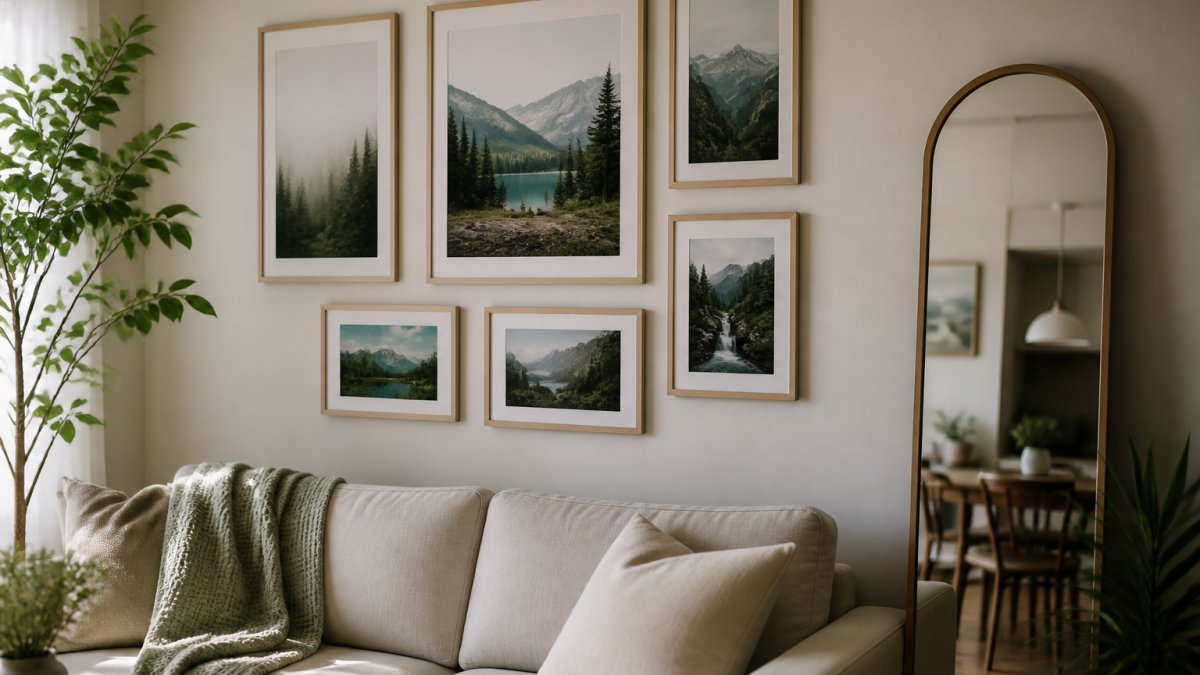
Keep frames lightweight and standard-sized so they fit new walls. A single large piece can anchor the arrangement, and a downloadable landscape like Still Lake Forest Reflection gives you a print you can re-frame if the next room calls for a different size.
Peel-and-Stick Wallpaper for Renters: What to Know Before You Apply
Peel-and-stick wallpaper is renter-friendly only if the wall can take it, and only if your lease allows it. Smooth, primed, fully cured paint is generally the safer surface. Freshly painted walls, textured finishes, and poorly adhered paint are where removable wallpaper can turn into a repair job.
What it costs. Pricing depends on the product, quantity, and the size of the wall. For current prices or a quote, check the Photos by Mark Page website. Compared with paint, removable wallpaper can be the pricier option, and its main advantage is that it comes down without a repaint.
Surface test before you buy. Cut a small square, apply it in a hidden corner, leave it for 3-5 days, then peel it back slowly at a low angle. If it lifts paint, stop, no brand will save that wall. Humidity matters too: bathrooms and kitchens with poor ventilation make adhesive-backed coverings more likely to bubble and fail.
Application and removal mechanics:
- Apply to a clean, dry wall; smooth bubbles out with a felt-edged tool, working from the center outward.
- Remove by pulling slowly at a low angle rather than yanking straight out, the same rule as adhesive strips.
- If residue remains, a damp cloth and mild dish soap usually lifts it; avoid abrasive pads that dull the paint.
If the wall fails the test or the lease forbids coverings, fall back to a tension-rod fabric hanging or a leaning display, both come down without a mark and cost less than a wallpaper accent wall.
Leaning Displays, Tapestries, and Other No-Hole Options
Leaning displays and fabric hangings need zero adhesive, which makes them the safest no-hole options for tricky surfaces. Lean oversized artwork or a statement mirror against the wall on a console or the floor, and secure the top with a small adhesive bumper to stop it sliding.
Wall tapestries and fabric hangings go up with a tension rod inside a window frame or a curtain rod over a bracket, and both come down without a mark. Corkboards and wire grid boards work the same way when you hang them from adhesive hooks rated for their weight.
Quick comparison of no-hole methods:
| Method | Best For | Surface Risk | Reusable |
|---|---|---|---|
| Adhesive strips | Frames, lightweight canvas | Low on flat paint | Sometimes |
| Tension rod | Tapestries, curtains | None | Yes |
| Leaning display | Oversized art, mirrors | None | Yes |
| Peel-and-stick wallpaper | Accent walls | Medium | Limited |
| Adhesive hooks | Corkboards, grid boards | Low | Sometimes |
Whichever method you choose, protect paint by removing slowly and never loading a strip past its stated limit.
Frequently Asked Questions
How can I decorate rental walls without damaging them?
Start with methods that leave no holes: adhesive strips and hooks for lightweight frames, leaning mirrors and oversized art against the wall, tension rods for curtains, and removable wallpaper or vinyl decals for accent walls. Test any adhesive on a hidden patch first and remove it slowly at a low angle to protect paint. Keep frames light and follow the product's weight rating. These approaches let you decorate rental walls affordably and take everything with you when you move.
Are peel-and-stick wallpapers safe for rental walls?
They can be, but surface matters. Smooth, painted drywall usually releases cleanly when you remove the paper slowly, while fresh paint, textured walls, and unsealed surfaces can peel or leave residue. Apply a small test strip in a closet or behind furniture for a few days before committing to a full wall. Check your lease first, since some landlords require written approval for any wall covering.
What is the cheapest way to decorate a blank wall?
Digital art downloads paired with inexpensive frames or clips give you the most wall coverage for the least money. You print at a local shop or at home, choose a size that fits your space, and swap prints seasonally without buying new hardware. Fabric hangings, corkboards, and wire grid boards are other low-cost options that cover large areas and move easily between rentals.
How do I hang pictures in a rental without nails?
Use adhesive strips rated for the frame's weight, adhesive hooks for lighter pieces, or a picture ledge that rests on the floor or a shelf. Clean the wall with rubbing alcohol, let it dry, press the strip firmly for the full time the instructions specify, and wait before hanging. For heavier art, lean it against the wall on a console or use a floor-standing easel rather than trusting an adhesive above its rating.
The hardest part of rental decorating isn't the hanging method, it's finding art worth hanging. Photos by Mark Page offers high-quality digital downloads of nature and everyday moments, plus custom collaborations that turn your own memories into professional-grade artwork. Every file is built for printing and framing, so you can decorate a rental without touching a nail. Get started with Photos by Mark Page and turn a blank rental wall into a calm, personal space you can take with you.